

A rainwater tank does different jobs depending on where you live in the region. In Wellington City, the Hutt Valley and Porirua it mostly takes pressure off the mains for the garden, toilets and laundry, and helps the garden through dry summers. On the Kāpiti Coast, where every home is metered, it can also cut the per cubic metre part of your water bill. On rural blocks with no town supply, the tank is the supply. We supply and install water tanks across Wellington: we help you pick the size and material, set the base, and plumb in the pump, first-flush diverter, filters and overflow so the tank works from day one.
We handle all of it: placement and sizing, connecting to spouting and downpipes, pressure pumps, first-flush diverters, filtration and UV, and any mains top-up with the backflow protection it needs.
Pricing: quotes are free, and every job gets a fixed price before we start, so there are no surprises on the invoice.
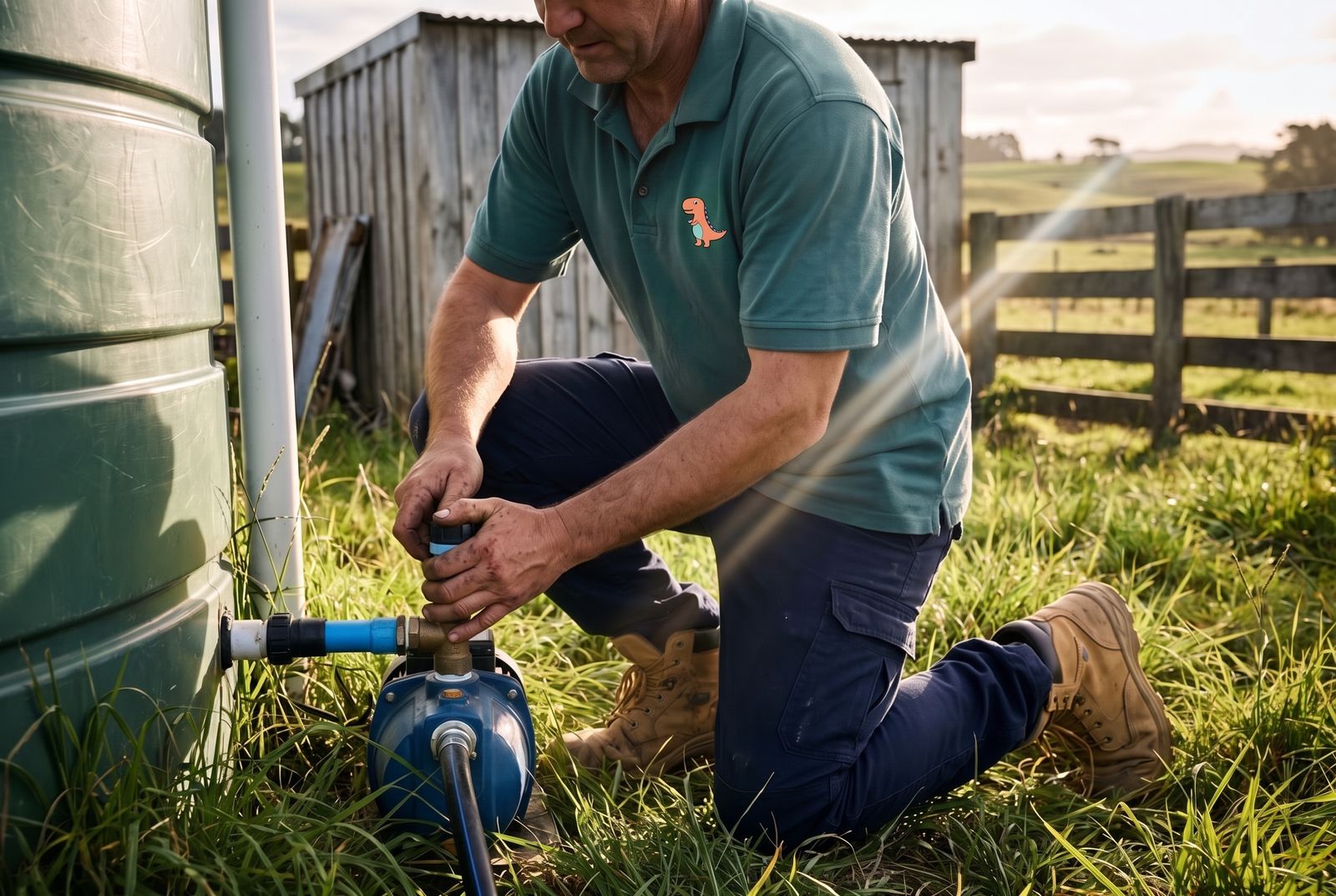
Water Tanks Jobs We Handle Across Wellington
- Rainwater tank installation
- Tank pump setups
- First flush diverters
- Tank top-up valves
- UV for tank water
- Leaking tank repairs
Restrictions, meters and why people add tanks
Tiaki Wai, which runs water for Wellington City, Lower Hutt, Upper Hutt and Porirua, uses four levels of water restrictions. Level 1 limits sprinklers and irrigation to alternate days at set morning and evening hours, Level 2 allows hand watering only, and Levels 3 and 4 ban most outdoor use. Level 1 applies all year round in Upper Hutt. The level changes with the season, so check the current level, and how it treats water from your own tank, with Tiaki Wai.
The Kāpiti Coast has had universal water metering since 2014, with a fixed charge plus a charge per cubic metre, so water from the roof used for toilets, laundry and the garden is water you are not buying. In Wellington, Hutt and Porirua most homes are unmetered, so the benefit there is mainly a backup supply and less demand on the mains in summer.
Rainfall and tank size
Rainfall varies a lot across the region. NIWA's 1981 to 2010 normals give about 957 mm a year at Wellington Airport, 1,009 mm at Paraparaumu, 1,206 mm at Gracefield in Lower Hutt, 1,268 mm at Wallaceville near Upper Hutt and around 1,800 mm at the Wainuiomata reservoir. Winter is the wettest season, and summer is when you draw on the tank most.
Tank size depends on the roof area that feeds it, how much you plan to use and how long you need to last through a dry spell. A small tank on a big roof overflows in every storm and still runs dry in February. On tight city sections, space is often the real limit, so slimline tanks along a side path are common. For garden use, we can connect the tank to garden irrigation with a pump sized for the job.
How It Works
Consent, internal plumbing and backflow
National guidance on building work that does not need consent covers some ground-level tanks used outdoors. Once a tank feeds toilets, the laundry or the kitchen, or is topped up from the mains, a building consent from your council is normally needed and the plumbing must be done by a licensed plumber. Councils here are Wellington City, Hutt City, Upper Hutt City, Porirua City and Kāpiti Coast District Council, and each can tell you whether your project needs consent.
Any link between a tank and the mains needs backflow protection so tank water can never flow back into the public supply. Kāpiti Coast District Council says every connection in its district needs some form of backflow prevention, and homes with two water sources may need more protection. We fit the right device and set up any mains top-up so it meets the standard.
Keeping tank water clean
Roof water carries leaves, bird droppings, dust and, near the coast, salt. Sediment settles on the tank floor over time, so tanks used for drinking need periodic water tank cleaning as well as treatment. Treatment works best in sequence:
- Leaf diverters or mesh on downpipes to keep debris out
- A first-flush diverter to dump the dirtiest water at the start of each rain
- Tank and pipe materials suitable for drinking water contact
- Sediment and carbon filtration after the pump
- UV disinfection where the water is used for drinking
Hill sections, wind and earthquakes
Many Wellington sections are steep, and a full tank is heavy. It needs a level, properly prepared base, and on a slope that base has to be built so it cannot slump. The tank should also be secured so it stays put in strong wind when it is nearly empty and in a strong earthquake when it is full, given the region sits on active faults.
Overflow needs somewhere safe to go. Saturated ground was linked to many of the slips in Wellington's wet winter of 2022, so we connect overflow to the stormwater system rather than letting it pour onto a bank or under the house.
What affects the cost
Every tank project gets a free quote, because sites vary so much. The main factors are:
- Tank size, material and whether it sits on the ground or a stand
- Base preparation and retaining on sloping sites
- Distance from downpipes and the house, and any trenching
- Outdoor taps only, or connection to internal plumbing
- Pump, pressure vessel, filtration and UV equipment
- Consent, mains top-up valve and backflow protection where needed
Why Choose Cheeky's Plumbers for Water Tanks
Consent checked before you buy
We check your plan with the rules before you order a tank, and where it feeds toilets or laundry or has a mains top-up, licensed plumbers do the work and the paperwork.
Bases built for slopes
On hill sections the base is prepared so a full tank cannot shift, and overflow is piped to stormwater, not onto the bank.
Tank, pump and plumbing together
One team connects downpipes, overflow, pump, filters and any mains top-up with backflow protection, so you are not coordinating trades.
Price agreed before work starts
Every tank job gets a free site quote and a fixed price before anything is dug or ordered.
Water Tanks FAQs
Do I need consent for a rainwater tank in Wellington?
Not always. Some outdoor-use tanks sitting on the ground are exempt under national guidance, but tanks feeding internal plumbing or with a mains top-up usually need consent. Check with your council, or we will check for you.
Can I use tank water during water restrictions?
Tank water is your own supply, but check the current restriction level and how it applies to tank water with Tiaki Wai before you rely on it.
Will a tank save me money on the Kāpiti Coast?
It can. Kāpiti homes pay a charge per cubic metre of town water, so roof water used for toilets, laundry and the garden reduces what you buy.
Can a tank supply my toilets and washing machine?
Yes. That needs a pump and usually a building consent, and the plumbing must be done by a licensed plumber.
Do I need backflow protection with a mains top-up?
Yes. Any connection between a tank and the mains needs the right backflow device to protect the public supply.
How often should a tank be cleaned?
Check gutters and first-flush devices regularly and inspect the tank for sludge. Many tanks need cleaning every few years.
Water Tanks Near You
Find your suburb for local water tanks information, response times and nearby areas.
Water Tanks Guides
- Is Wellington Water Hard or Soft? What It Means for Filters and Cylinders
- Emergency Water Storage for Wellington Homes: How Much and Where to Keep It
- Wellington Water Restrictions: What Level 1 Means for Your Garden and Hose
Related Services
Water Filters
Whole-house and under-sink filtration for cleaner, better-tasting water.
View serviceWater Pumps
Pressure pumps, tank pumps, bore pumps and sump pumps supplied, installed and repaired.
View servicePressure Reducing Valves
Mains pressure in some streets can be high enough to damage tapware, burst flexi hoses and wear out cylinders early.
View serviceIrrigation
Drip lines, sprinklers and smart controllers designed for your section and plumbed in by licensed plumbers, with the right backflow protection for a garden irrigation supply.
View serviceBlocked Drains
Blocked sinks, showers, toilets and gully traps cleared fast.
View serviceHot Water Cylinders
Hot water cylinder replacement across Wellington.
View serviceSources and further reading
- Tiaki Wai: water restrictions
- Kāpiti Coast District Council: water rates
- Kāpiti Coast District Council: your water connection and backflow
- NIWA: The Climate and Weather of Wellington (2nd ed., 2014)
- Building Performance: building work that does not need a building consent
- Taumata Arowai: acceptable solution for roof water supplies