

Good water pressure feels like a luxury until it starts breaking things. When the pressure coming into a house is too high, every tap cartridge, toilet valve, flexi hose and cylinder valve works harder than it was designed to. Parts wear early, joints weep, and pipes bang when a tap snaps shut.
A pressure reducing valve, often called a PRV, sits on your main supply and holds the pressure inside the house at a steady, safe level, whatever the network is doing outside. We test what you are actually getting, fit the right valve and set it to suit your fixtures.
Pricing: quotes are free, and every job gets a fixed price before we start, so there are no surprises on the invoice.
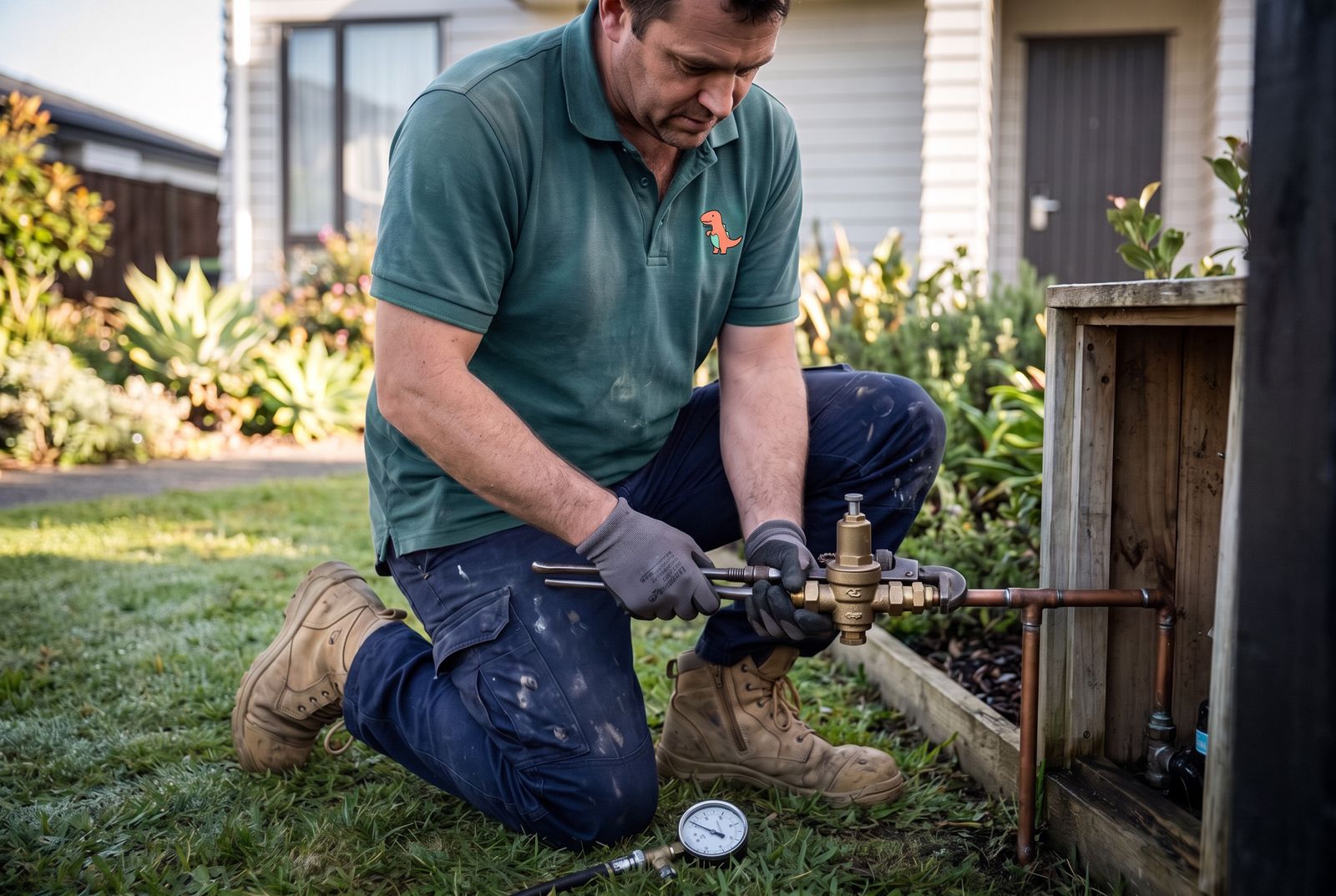
Pressure Reducing Valves Jobs We Handle Across Wellington
- Pressure reducing valve installation
- PRV replacement
- High mains pressure fixes
- Water hammer
- Pressure testing
- Flexi hose protection
Signs your pressure is too high
High pressure rarely announces itself directly, though water hammer is a common clue. Look for:
- Banging or shuddering pipes when a tap or appliance shuts off
- Flexi hoses bulging, kinking or failing early
- A cylinder relief or expansion valve dripping constantly
- Tap cartridges and toilet inlet valves wearing out quickly
- Showers that are harsh and splash out of the tray
- Leaks coming back at joints that were recently repaired
What the rules say about pressure
Water supply in New Zealand homes falls under Building Code clause G12, with AS/NZS 3500.1 commonly used as the technical standard. AS/NZS 3500.1 limits static pressure at outlets inside a building, other than fire service outlets, to 500 kPa. Many tapware and appliance makers also set maximum inlet pressures in their installation instructions, and running above them can affect warranties.
MBIE has issued a product recognition notice covering WaterMark-certified inlet pressure control valves, which gives a recognised route for compliant valves. We only fit valves approved for use on New Zealand drinking water supplies. High pressure is also a common cause of water hammer, so fixing the pressure often fixes the banging too.
How It Works
How we fit and set a valve
We start by measuring static pressure at your point of supply, ideally with a gauge that records the peak, because pressure often climbs overnight when demand drops. If it is higher than your home should see, we fit the valve on the main supply on your side of the toby, with an isolation valve and strainer to protect it. On the Kāpiti Coast the valve goes after the meter in the manifold box or where the supply enters the house.
The valve is set to suit your fixtures and cylinder, usually well below the 500 kPa limit. We then check the cylinder valves, relief valve and any expansion control valve, because they all interact with the new pressure setting.
High pressure costs more than worn parts. A relief valve that drips around the clock sends hot water you have paid to heat straight down the drain, and on the metered Kāpiti Coast you pay for the water as well. In the rest of the region most homes are unmetered, so that waste goes unnoticed unless someone spots the tundish or overflow pipe running.
What affects the cost
Pressure reducing valves are fitted. The total depends on:
- Pipe size and material at the installation point
- Valve type and whether a strainer and isolation valve are needed
- Access to the toby, the meter box or where the supply enters the house
- Replacing an existing failed valve versus a new installation
- Related work such as cylinder valve or flexi hose replacement
Pressure in a city of hills
Static water pressure depends largely on how far below its supplying reservoir a house sits. In a city built on hills, that means two homes in the same suburb can see very different pressure. A house at the foot of a slope in Ngaio, Brooklyn or Wainuiomata may get far more than a neighbour higher up, while homes near the top of a zone can have the opposite problem and need help with low water pressure instead.
Tiaki Wai describes its network as largely 30 to 100 years old, and network changes can shift the pressure a house receives. A valve that was never needed when the house was built may be worth fitting now. Valves also wear: seats and diaphragms degrade, grit lodges inside, and a failing valve can let pressure creep up overnight. If your relief valve has started dripping or your hoses keep failing, test an existing valve before replacing anything else.
Why Choose Cheeky's Plumbers for Pressure Reducing Valves
Peak pressure measured
We record pressure over time where we can, not just a single reading, because the overnight peak is what wears fittings out.
Approved valves only
We fit valves approved for New Zealand drinking water supplies, with a strainer and isolation valve to protect them.
Set to suit your fixtures
The valve is set for your tapware, appliances and cylinder, not left at a factory figure.
Expansion managed too
We check the cylinder relief and expansion control valves, which work alongside the new pressure setting.
Fixed price before we start
Pressure reducing valves are fitted, with the total agreed before any work begins.
Pressure Reducing Valves FAQs
What water pressure is too high?
AS/NZS 3500.1 limits static pressure at outlets inside a building to 500 kPa. Anything near or above that is worth reducing.
Will a pressure reducing valve weaken my shower?
Only to a safe level. Most people notice the shower is steadier, not weaker, once the surges are gone.
How do I know if my pressure is high?
Banging pipes, dripping relief valves and repeated hose failures are common clues. A pressure test at the point of supply confirms it.
Do pressure reducing valves wear out?
Yes. Seats and diaphragms degrade over time. If problems return, test the valve before replacing other parts.
Why is my cylinder relief valve dripping?
It can be high mains pressure, a failing valve, or thermal expansion with no expansion control. We test to find out which.
Do I need a valve if I already have one on the cylinder?
A cylinder valve controls the hot side only. A main pressure reducing valve protects the cold side and every fixture as well.
Pressure Reducing Valves Across Wellington
Our pressure reducing valves team works in every Wellington suburb. Find your local plumbers:
Related Services
Water Filters
Whole-house and under-sink filtration for cleaner, better-tasting water.
View serviceWater Tanks
Rainwater tank installation, pump setup and maintenance for rural and urban properties across the Wellington region.
View serviceWater Pumps
Pressure pumps, tank pumps, bore pumps and sump pumps supplied, installed and repaired.
View serviceIrrigation
Drip lines, sprinklers and smart controllers designed for your section and plumbed in by licensed plumbers, with the right backflow protection for a garden irrigation supply.
View serviceBlocked Drains
Blocked sinks, showers, toilets and gully traps cleared fast.
View serviceHot Water Cylinders
Hot water cylinder replacement across Wellington.
View service