

Stormwater drains carry rain off your roof, driveway and paths and away from the house, either into the public stormwater network, out to the kerb, or to a soakage system on site. When they block or break, you usually find out in a downpour: water spilling from the top of a downpipe, a sump that stays full, or a puddle creeping towards the cladding.
In Wellington the stakes are higher than in a lot of places. NIWA's climate normals put Wellington Airport at about 957 mm of rain a year, Lower Hutt at around 1,200 mm and the Wainuiomata reservoir at about 1,800 mm, with winter the wettest season. On a hillside section, water from a broken stormwater pipe does not just make a puddle; it soaks into a bank. We clear, repair and upgrade private stormwater systems from Brooklyn and Ngaio to Stokes Valley, Titahi Bay and Paraparaumu.
Pricing: quotes are free, and every job gets a fixed price before we start, so there are no surprises on the invoice.
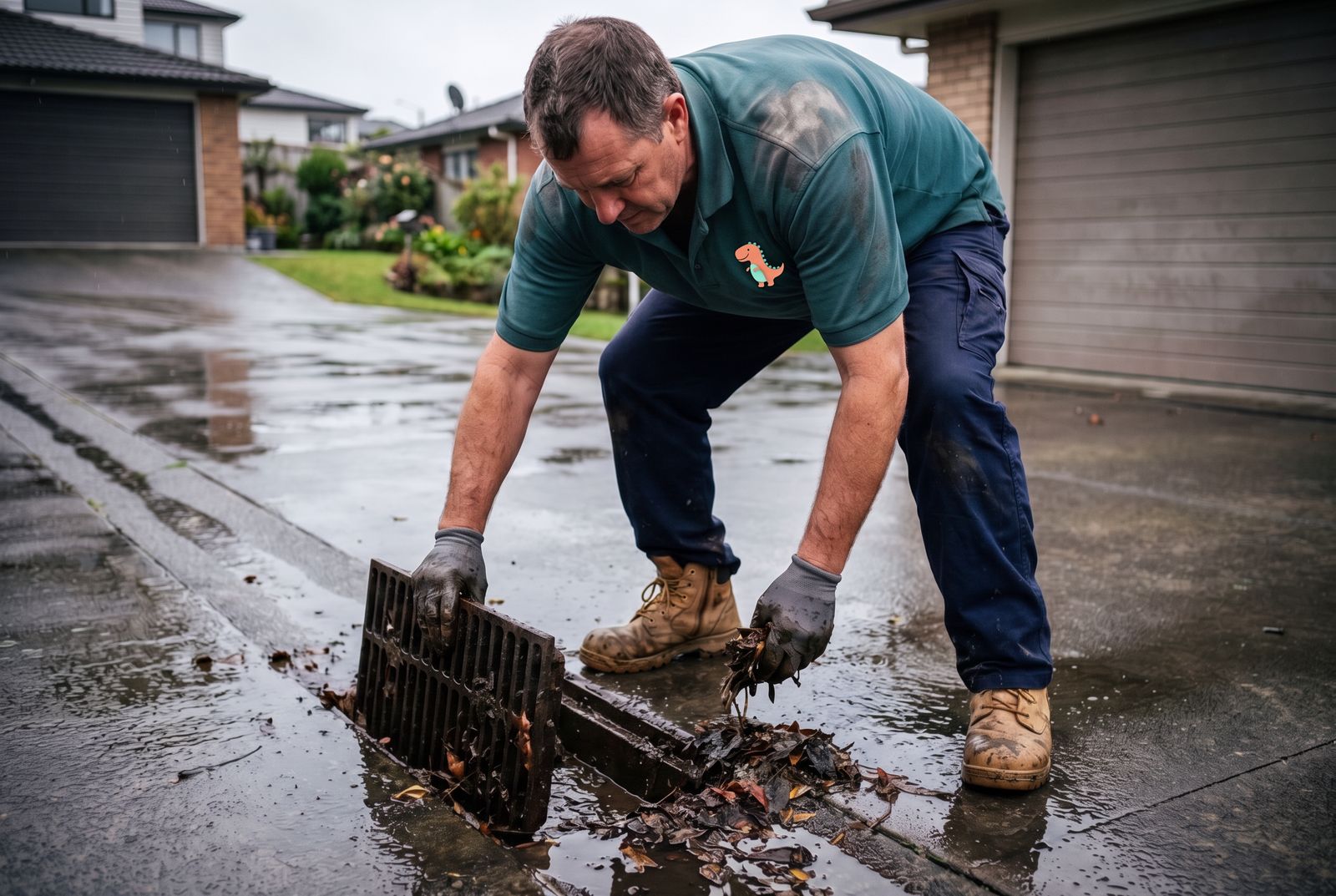
Stormwater Drains Jobs We Handle Across Wellington
- Stormwater drain clearing
- Stormwater and drainage repairs
- Sump and cesspit cleaning
- Soakhole repairs
- Channel drains
- Flooding and ponding fixes
Signs your stormwater system is struggling
Stormwater faults show up in wet weather. Look out for: New stormwater lines, soak pits and connections for extensions are laid by our drainlaying team.
- Downpipes overflowing at the joint or spilling from the top in heavy rain
- Sumps and grates that hold water long after the rain stops
- Water ponding against the house, garage or a retaining wall
- A damp subfloor or water in the basement after a storm
- Scouring or a wet, soft patch where a pipe discharges on a slope
- A soakage pit that overflows in only moderate rain
Hillsides, slips and where the water goes
July 2022 was Wellington's wettest July on record, and around 670 slips were recorded between 1 July and 22 August that year. GeoNet linked those slips to saturated soil and to older ground that had been cut and filled decades ago. Wellington City Council's guidance is that slips on private land are the landowner's responsibility.
We cannot promise a stormwater fix will stop a slip, but water pouring out of a cracked pipe or a disconnected downpipe onto a bank is something you can control. We trace where every downpipe and sump on the section ends up, repair broken lines, and pipe the water to a proper outlet rather than letting it soak into a cut slope or the fill behind a retaining wall.
How It Works
Common stormwater problems we find
Leaves, moss and roof grit wash into downpipes and settle in the first bend or in a sump that has not been cleaned. Strong winds add their share of leaves and twigs to the mix. Silt from gardens and gravel drives builds up in pipes on sloping sections. Roots find their way into stormwater lines just as easily as sewers, and older earthenware pipes crack with age and ground movement.
Cracked lines under a driveway or path can often be fixed with no-dig pipe relining instead of digging up the concrete. Plenty of homes also have paving, decks and extensions have been added over the years without anyone upsizing the drainage to cope.
Downpipes in the wastewater: cross connections
Roof water belongs in the stormwater system, not the sewer. Tiaki Wai's guidance is clear that downpipes must connect to stormwater, and if a downpipe is feeding a gully trap it needs redirecting. We still find plenty of them, usually from old DIY work or an extension, along with yard sumps tied into the wastewater line.
Master Plumbers notes that stormwater getting into the wastewater network can push volumes at treatment plants up to five times dry-weather levels, which is part of why sewers overflow in heavy rain. If we find a cross connection during a job, we tell you and quote to move it to the right pipe. It is a straightforward fix, and it also stops a gully trap overflowing every time it pours.
Who looks after which pipes
Public stormwater pipes in Wellington City, the Hutt Valley and Porirua are run by Tiaki Wai, and faults in them are fixed through its renewals programme. Private drains on your property are the owner's job, and the detail depends on where you live because each council's rules differ slightly. Upper Hutt, for example, makes stormwater laterals the owner's responsibility all the way down to the point of discharge. An easement pipe that crosses your land but does not serve your home is not yours to fix.
On the Kāpiti Coast, Kāpiti Coast District Council runs stormwater itself. Wherever you are, if we find a fault on the public side, we give you the location and footage to pass on.
What stormwater work costs
Heavily silted lines may need hydro jetting, and where a line keeps blocking or looks broken we recommend a CCTV drain inspection before anyone digs.
Repairs, cross connection fixes, new outlets and system upgrades are quoted free once we have seen the site. Larger work, or a new connection to the public network, may need building consent and sign-off from your council or Tiaki Wai, and we arrange that with you.
Why Choose Cheeky's Plumbers for Stormwater Drains
Every outlet traced
We find where each downpipe and sump actually discharges, so nothing is left running onto a bank.
Camera before the spade
Where a line looks broken, we inspect it first so any digging happens in the right spot.
Cross connections fixed
Roof water going into the sewer is redirected to stormwater, the way Tiaki Wai requires.
Stormwater Drains FAQs
How much does it cost to clear a stormwater drain in Wellington?
Heavy silt, long runs or a camera inspection add to the price, which we confirm before starting.
Can my downpipe go into the gully trap?
No. Tiaki Wai says roof downpipes must connect to the stormwater system, not wastewater. A downpipe feeding a gully trap needs redirecting, and we can do that for you.
Who is responsible for stormwater drains on my property?
The property owner looks after private drains, sumps and outlets. The exact boundary depends on your council; Upper Hutt, for example, makes stormwater laterals the owner's job down to the point of discharge.
Can a broken stormwater pipe cause a slip?
Water discharging onto a bank or soaking into fill is one of the things that can make a hillside less stable. Fixing the pipe and sending the water to a proper outlet takes that risk away.
Why does my soakage pit overflow?
Soakage pits silt up over time, and some were never big enough for the roof and paved area they now serve. We can clean, test and quote to upgrade or replace it.
Can tree roots get into stormwater pipes?
Yes. Older earthenware stormwater lines are just as vulnerable at the joints as wastewater drains.
Stormwater Drains Across Wellington
Our stormwater drains team works in every Wellington suburb. Find your local plumbers:
Stormwater Drains Guides
Related Services
Blocked Drains
Blocked sinks, showers, toilets and gully traps cleared fast.
View serviceDrain Cleaning
Regular drain cleaning removes fat build-up, sludge and root growth before they turn into a blockage.
View serviceCCTV Drain Inspection
Our waterproof drain cameras show exactly what is happening inside your pipes: roots, cracks, sags, collapsed sections and illegal connections.
View serviceHydro Jetting
High-pressure water jetting scours the full diameter of your pipe, cutting through roots, grease and silt that an eel just punches through.
View serviceHot Water Cylinders
Hot water cylinder replacement across Wellington.
View serviceEmergency Plumber
Water through the ceiling at 2am does not wait for business hours, and neither do we.
View serviceSee all drainage services or every service we offer.
Sources and further reading
- Tiaki Wai: Knowing your pipes
- Tiaki Wai: Fixing your lateral
- NIWA: The Climate and Weather of Wellington (2nd ed., 2014)
- GeoNet: Wellington slips news
- Newshub: Wellington slips after wettest July on record (2022)
- Newstalk ZB: Wellington City Council slip guide
- Master Plumbers: Keep NZ clean (cross connections)