
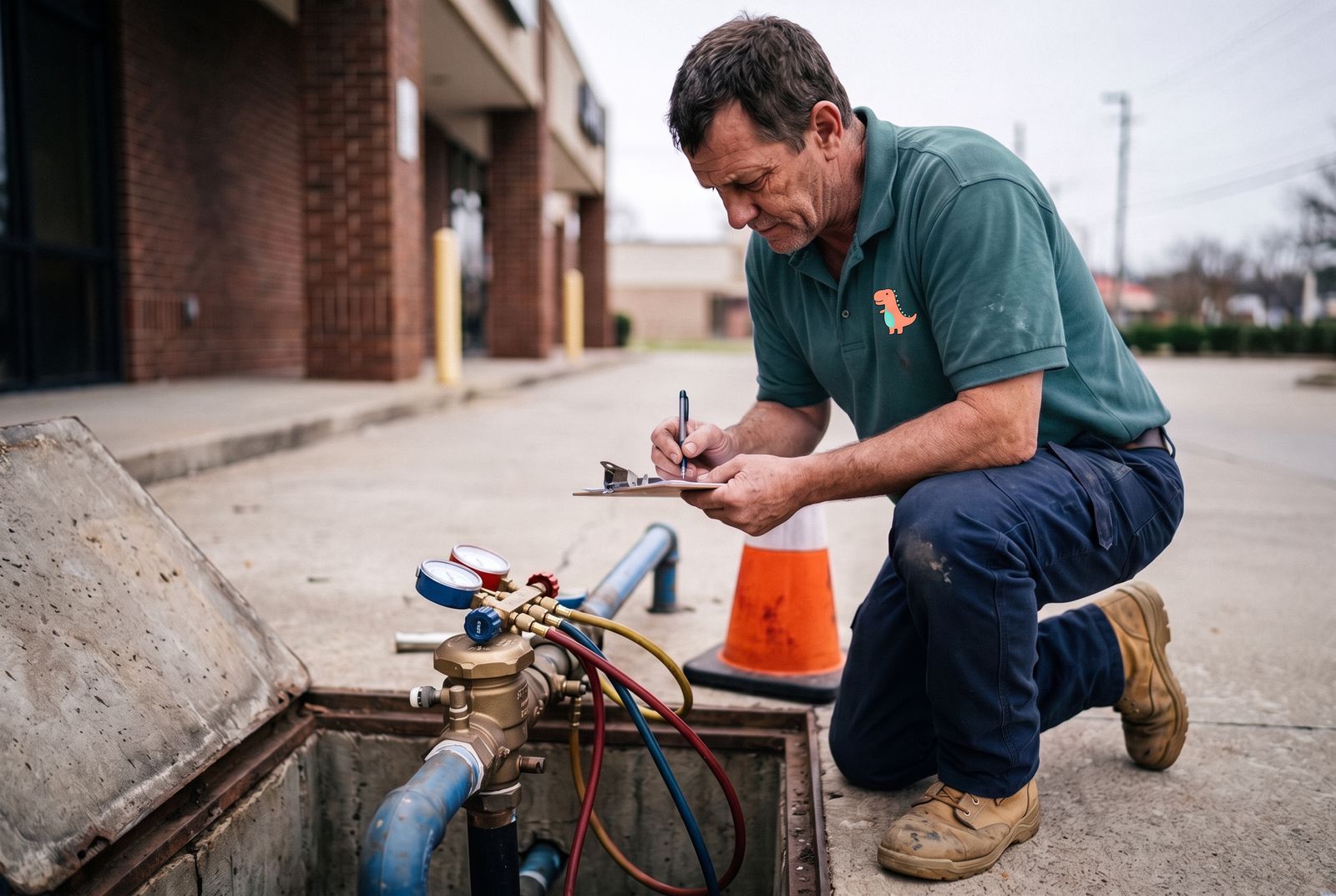
Backflow is water running the wrong way, from a property back into the public supply. It can happen when pressure in the main drops, during a burst or heavy firefighting demand for example, and it can draw in water from irrigation lines, chemical dosing systems, boilers, pools or a second water source. A backflow prevention device is there to stop that, but only if its valves still seal.
That is why testable devices are tested once a year under the NZ Backflow Testing Standard. We test, service and replace devices for homes, lifestyle blocks, cafes, schools, workshops and apartment buildings across Wellington City, the Hutt Valley, Porirua and the Kāpiti Coast, and we keep the paperwork straight.
Pricing: quotes are free, and every job gets a fixed price before we start, so there are no surprises on the invoice.
Backflow Testing Jobs We Handle Across Wellington
- Annual backflow testing
- Backflow preventer installation
- Residential backflow preventers
- Commercial backflow devices
- Council test certificates
- Failed device repairs
Who needs backflow testing in the Wellington region
The rules come from two places. Devices inside a building that are listed on its compliance schedule are tested by an Independently Qualified Person (IQP) as part of the building warrant of fitness, under the national Building Act system. Boundary devices protect the public network itself, and how they are managed depends on who supplies your water.
In Wellington City, the Hutt, Upper Hutt and Porirua the network is run by Tiaki Wai, which took over from Wellington Water on 1 July 2026. A Wellington Water procedure called for the right boundary devices on potentially hazardous sites, kept working through regular testing with the results kept on file. Check with Tiaki Wai for the current requirements on your site. On the Kāpiti Coast the council is clear: every connection in the district needs some form of backflow prevention, with the type set by the activity and risk. Commercial sites often have both boundary and internal devices, which is why backflow sits alongside the rest of our commercial plumbing work.
You probably need a test if any of these apply:
- You have received a reminder from your council, Tiaki Wai or your building manager
- Your building has a compliance schedule and a building warrant of fitness
- There is irrigation, a pool, a boiler, a fire sprinkler system or chemical dosing on site
- Your property has two water sources, such as town supply plus a tank or bore
- You run a cafe, salon, medical practice, workshop or factory
- A new device has been installed and needs commissioning
Device types and hazard levels
The device required depends on how much of a risk the property poses to the drinking water supply. Building Code guidance for water supplies groups them broadly like this, and the final choice for your site depends on the specific activity:
- High hazard, such as chemical dosing, laboratories and some medical sites: reduced pressure zone (RPZ) device
- Medium hazard, such as garden irrigation and some commercial kitchens: double check valve
- Low hazard, which covers most standalone homes: an air gap or a hose connection vacuum breaker
- Kāpiti homes with a fire sprinkler, an irrigation meter or two water sources may need more protection than a standard house
How It Works
What happens if a device fails
A failed test is common and not a disaster. Rubber seals and check valves wear, and grit from the mains can stop a valve seating properly. The device then needs servicing and a retest before it can be signed off.
When a device fails, we tell you on the spot, explain why, and give you a fixed price to service or replace it. Most valves can be rebuilt with a parts kit on the same visit and retested straight away, so you are not waiting on a second booking. If the device is the wrong type for the hazard, or has been installed somewhere that cannot be tested safely, we will say so and quote to put it right.
What affects the cost
Your total depends on:
- Number of devices on site, including any on irrigation or fire supplies
- Device type: an RPZ takes longer to test than a double check valve
- Access, such as devices in locked plant rooms, deep pits or on a steep section
- Any repairs, parts kits or replacements needed after a failed test
Records that land in the right place
A test only counts if the record reaches the right person. For internal devices on a compliance schedule, we provide the documentation your IQP and building warrant of fitness need. For boundary devices, we complete the test results in the form your water supplier or council asks for.
We keep a record of every device we test, with location, serial number, results and parts used, and we contact you before the next annual test is due. That matters for the apartment buildings around Te Aro and Thorndon, where several devices can sit in one plant room. For landlords and body corporates, the same register covers every site they manage, which is a large part of our property manager plumbing service.
Why Choose Cheeky's Plumbers for Backflow Testing
Same-visit repairs and retests
When a device fails, most valves can be rebuilt with a parts kit and retested on the same visit, so you are not waiting on a second booking.
Paperwork done properly
Internal devices get the documentation your building warrant of fitness needs, and boundary results go to your water supplier or council in the form they ask for.
A register with reminders
We keep a record of every device we test, with location, serial number, results, photos and parts used, and contact you before the next test is due.
Fixed price for any fix
If a device needs servicing or replacing, you get a fixed price before we start.
Backflow Testing FAQs
How often does a backflow device need testing?
Testable devices are tested every year. That is standard practice under the NZ Backflow Testing Standard and the usual requirement on a compliance schedule.
Does my house need backflow testing?
Only if a testable device has been installed, which is common with irrigation, some rural supplies and homes with two water sources. On the Kāpiti Coast every connection needs some form of backflow prevention, but not every home has a testable device.
What is an IQP?
An Independently Qualified Person, registered with a council to inspect and test specified systems, such as backflow devices, for a building warrant of fitness.
How long does a backflow test take?
Usually 20 to 30 minutes per device, depending on the type and how easy it is to reach.
Who looks after backflow now Wellington Water has gone?
From 1 July 2026 Tiaki Wai runs water services for Wellington City, the Hutt, Upper Hutt and Porirua. Kāpiti Coast District Council runs its own. Check with your supplier for any site-specific requirements, and we will test to them.
What if my device fails?
We explain why, give you a fixed price to service or replace it, and usually rebuild and retest it on the same visit.
Backflow Testing Across Wellington
Our backflow testing team works in every Wellington suburb. Find your local plumbers:
Related Services
Emergency Plumber
Water through the ceiling at 2am does not wait for business hours, and neither do we.
View serviceLeak Detection
A hidden leak can run day and night and quietly rot the framing behind your walls.
View serviceBurst Pipes
Burst pipes cause more water damage in Wellington homes than almost anything else, especially in older villas and bungalows with galvanised steel or early polybutylene pipe.
View serviceRepiping
Old galvanised steel and grey polybutylene pipes fail with age.
View serviceBlocked Drains
Blocked sinks, showers, toilets and gully traps cleared fast.
View serviceHot Water Cylinders
Hot water cylinder replacement across Wellington.
View serviceSee all plumbing services or every service we offer.